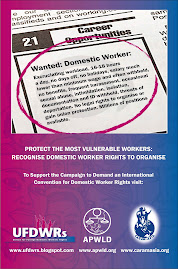
Monday, 14 February 2011

Urgent Appeal for Decent Work for Domestic Workers


Dear friends, DW organizations/unions/network, trade unions/network, women, human rights, labour,  organizations/networks

Greetings of solidarity from Jala PRT Indonesia,

Sisters and brothers, on 15th February 2011, we in Indonesia will commemorate the 5th Indonesian Domestic Workers Day since the day was launched in 2007. The background to this Domestic Workers Day surrounds the case of 14 year-old domestic worker Sunarsih, who was assaulted by her employer leading to her death in 2001, in the city of Surabaya.

Every year fellow domestic workers, domestic workers organizations and unions and the domestic workers network - JALA PRT - together with organizations and trade unions: KSBSI, KSPI, KSPSI, FSPMI, women's organizations that are concerned with the issue of domestic workers, commemorate DOMESTIC WORKERS DAY and remind the state, especially the Government and Parliament, about their continued failure to provide protection and to fulfil the rights of domestic workers. The momentum of this day is also used to campaign publicly on the importance of household work and domestic workers. In Indonesia, where the community is extremely dependent on the role and work of domestic workers, many employers and their families would be unable to work and do other activities if there were no domestic workers, for example during Eid el Fitri holidays when domestic workers usually return home to their village.

This 5th anniversary means that 10 years has passed since the death of Sunarsih, yet there has been no change with regards to the protection of domestic workers in Indonesia. As we know, Indonesia is a   country with one of largest numbers of domestic workers, including 10 million local domestic workers and six million migrant domestic workers. Ten years has passed but may other “Sunarsih” incidents still continue to occur and have even increased.

At the end of 2010, the Indonesian Parliament had planned to discuss the draft law on the Protection of Domestic Workers in 2010. However the plan was then abandoned. Similar to the Indonesian Parliament, the Government also does not seem to have the political will to pass a domestic workers law, and does not support an ILO Convention for the protection of domestic workers that was discussed during the 99th Session of the ILC (International Labour Conference) from 3 to 18 June 2010 in Geneva. The Government of Indonesia, as the country with the largest number of domestic workers in Asia and well as in the world, should be very concerned about the protection of domestic workers, yet it did not support the Convention. This attitude of the Indonesian Government and Parliament has allowed for the systematic violation of the rights of domestic workers.

Therefore we need to continue to advocate and collectively urge the Government and Parliament to take responsibility for the protection of domestic workers by deliberating and implementing a Domestic Workers Protection Act and support the establishment of the ILO Convention and Recommendations concerning decent work for domestic workers and ratify it.

Considering the situation of domestic workers, and the opportunities and momentum this Domestic Workers Day brings in Indonesia, we would like to invite our fellow friends, brothers and sisters, domestic workes organization/union, trade unions, women's organizations and various human rights, and workers organizations, networks to join together and urge the Government and Parliament, by writing and sending a Letter of Appeal, in support and in solidarity with Indonesian domestic workers to encourage the Government and the Parliament to immediately pass the Domestic Workers Bill and support the Convention on Decent Work for Domestic Workers at the 100th Session of the ILC in June 2011.

Please send your letter of solidarity via email to
jala_prt@yahoo.com.

We conclude by conveying our gratitude for your spirit and solidarity.
In Solidarity:
-     JALA PRT (National Network for Domestic Workers Advocacy)
-     Serikat PRT Tunas Mulia (Tunas Mulia Domestic Workers Union)
-     Kongres Operata Yogyakarta
-     Organisasi Pekerja Rumah Tangga Teratai Medan (Teratai Domestic Workers Organization from Medan)
-     Organisasi Pekerja Rumah Tangga Merdeka Semarang (Merdeka Domestic Workers Organization  from Semarang)
-     Persatuan Pekerja Rumah Tangga Jakarta (Domestic Workers Unity from Jakarta)
-     Komite Aksi Pekerja Rumah Tangga (Domestic Workers Action Committee): KSBSI, KSPI, KSPSI, FSPMI, SBMI
-     Asia Pacific Forum on Women, Law and Development

Thursday, 27 January 2011

Domestic workers excluded from the wage hike in Taiwan


Press Release
24 January 2011
   
Exclusion of HSWs in new minimum wage in Taiwan is discriminatory and unjust

“While the new minimum wage is a welcome news, the exclusion of almost half of foreign workers in Taiwan who are caregivers or work in households makes it discriminatory and unjust.”

This was declared today by Joram Calimutan, program coordinator, of the Asia Pacific Mission for Migrants (APMM), a regional migrant centre based in Hong Kong as Taiwan’s Council of Labor Affairs earlier announced a new minimum wage for industrial-, agricultural-, and institution-based workers for this year.

The recent increase in minimum wage adjusted the monthly minimum salary to NT$17,880.00 from NT$17,280 or an hourly minimum rate of NT$98 from NT$95.

“The exclusion of household service workers (HSWs) who are mostly women from the Philippines and Indonesia reflects that the government of Taiwan merely views them as cheap labor. It is no different from other governments, like in Hong Kong, that do not recognize domestic workers as decent work. The Taiwan government does not even include the HSWs and house-based caregivers/ caretakers to its Labor Standards Law,” he remarked.

Calimutan added that the new policy puts HSWs in a more lamentable situation as they already work for over 12 hours a day, on-call for 24 hours, have irregular holidays and rest days, and already suffer physical, sexual, moral and verbal abuse from their employers.

“On top of these, they still suffer from the high fees that brokers in Taiwan charge. These unscrupulous brokers extort money from foreign workers who are forced to give in to their demands just so they can get or keep their jobs. The exclusion only adds up to the vulnerability of HSWs,” he remarked.

Calimutan also mentioned that, “the recent wage announcement exposes the non-compliance of Taiwan government to International Labor Organizations standards and disrespects of human rights and dignity of workers. The ILO already made a ruling against the exclusion of foreign domestic workers to labor ordinance of its member countries”.

On ILO’s declaration on fundamental principles and rights at work, Item 2.c. states the elimination of discrimination in respect of employment and occupation.

Today based on Philippine Overseas Employment Administration there are about 25,000 Filipino HSWs in Taiwan. “Countries like the Philippines should lodge protests with concerned bodies and assert the right of their nationals against discrimination. They should show their will to protect their workers and not be merely content with the income that their respective governments generate from their nationals in Taiwan,” he added.

APMM said that they will coordinate with various organizations in Taiwan in order to come up with plans on how the exclusion can be challenged both in Taiwan and in the international arena.

“Foreign workers in Taiwan are always some of the first to get hit by anti-labor policies of the government. Now, even policies that may prove beneficial to them are denied from half of the total foreign workers in Taiwan. This has got to stop,” Calimutan concluded.

Reference:      Joram Calimutan
                 Program Coordinator
                 Tel. (852) 2723-7536 / 5360-5497


Tuesday, 25 January 2011

Other positive news on domestic workers around Asia

Karnataka Domestic Workers’ Movement members marched through the streets of Bangalore on January 8 and presented a memorandum of demands to the labour minister. Protesters wore aprons with the message “domestic workers are workers”. Their demands include one day off a week, recognition of domestic work under the unorganised sector, formation of a separate welfare board of domestic workers, compulsory enrolment of all domestic workers with the labour department, and inclusion of domestic workers under the Protection of Women Against Sexual Harassment at Workplace Bill. (from WSWS.org)

A Bangladesh delegation put forward demands to the Gulf Cooperation Council (GCC) states at a two-day conference beginning Jan 18th in Dubai of the United Arab Emirates (UAE). The demands included extending the tenure of job contracts to five years and setting a minimum wage of $300 for its workers in the Gulf countries. This is important as there is no current minimum wage for migrant domestic workers.

The flow-on consequences of the Malaysian ban

Since Indonesian domestic workers were banned from working in Malaysia after the string of "maid abuses" publicized in the media, there has been a lot of flow on effects which need to be considered.

From the Indonesian side of the ban, many Indonesian women are unable to work as domestic workers in Malaysia, who either have worked there before or wanted to work in a country close by and with a similar culture. Instead they are forced to go to further away, such as to the Arab countries, where the culture is very different and the employment conditions not much better than Malaysia. On the positive side there was recently a report that Singapore is wanting to attract more Indonesian domestic workers. According to a resent article in TODAYonline, 17 employment agencies, in Singapore will be increasing the monthly salaries of new Indonesian domestic workers from $380 to $450 to compete with Hong Kong and Taiwan (which still pay a much higher rate) apparently there will be no change in the Foreign Placement Fee, but that remains to be seen. The other effect for Indonesians is that since the legal channels are shut, more domestic workers are being smuggled or trafficked into Malaysia then ever before, this is a major concern. Such as the case of Sopiati’s (not her real name) punched almost daily by her employers in Rawang, where she worked for six months without pay after being brought into the country illegally (reported in The Star online). With the shortage of domestic workers in Malaysia, it is the illegal and unscrupulous agents which are benefiting. 

Prior to the ban, Indonesia was sending 3,000 domestic helpers to Malaysia a month, 80% of Malaysians domestic workers! So you can image the shortage of domestic workers that Malaysia is currently facing, apparently 50,000 households are on waiting lists. This means that desperate households may be less careful about the agency that their domestic workers come from. The Malay Mail recently ran an interesting story (I don’t care: its a 'maid' problem) on how a household was told that they would have to wait 6 months for a domestic worker, but a unscrupulous agent offered one straight away for much cheaper, its unsurprising that many would take this option. Malaysia is currently trying to deal with the problem by getting more domestic workers in from Cambodia, although apparently they are less likely to renew their contracts and there is a shortage of Cambodian domestic workers willing to fill the vacuum. 

At this stage it would be good for everyone if Malaysia could agree to the extra conditions that the Indonesian government is asking for and sign the new Memorandum of Understanding (MOU), they should include migrant domestic workers in their labour laws, give them at least one day off a week, a minimum wage and the right to keep their documentation. Malaysia needs to recognise domestic work as work. 

Friday, 14 January 2011

Good news from UAE

Good news for Filipinos and other foreign workers in the United Arab Emirates (UAE): this year, foreign workers there with an expired job contract may obtain a new work permit and transfer to another employer without facing the six-month ban period and without the consent of their sponsor.
For more information and to see the conditions click here