Monday, 15 March 2010
100 Years old Women’s Day: Migrant Women Robbed Off Rights
KUALA LUMPUR 8 March, 2010: 100 years after the world recognized the role of women in society, women are still robbed off their rights. Read...


Thursday, 10 December 2009
Human Rights for Migrant Domestic Workers
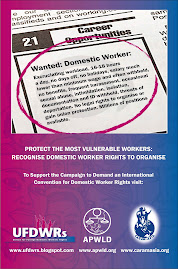
 KUALA LUMPUR, 10 Dec 2009: As the world marks International Human Rights Day today, CARAM Asia launches an online petition campaign seeking crucial support and commitment from every employer to grant a weekly paid day off to their migrant domestic worker (MDW). From today onwards, the online campaign will be featured for 30 days on the major media online sites based in Malaysia, Singapore, Thailand, Hong Kong, and the Middle East:
 1. http://www.malaysiakini.com/
2. http://theonlinecitizen.com/
3. http://www.prachatai.com/
4. http://www.thestandard.com.hk/
5. http://english.aljazeera.net/
A simple click is all is needed to grant a basic fundamental right to one of the most vulnerable group of human beings today..: http://www.petitiononline.com/adayoff/petition.html
Read more...
Monday, 29 June 2009
Rights for Foreign Domestic Workers Must be Enshrined in Law
Letter By CARAM Asia:
The recent decision by the Indonesian government to temporarily halt the sending of domestic workers highlights the increasing call to readdress the protection framework of foreign domestic workers (FDW). While this initial move will hopefully make the Malaysian government readdress the social, political and health rights of FDW, any permanent banning will lead to an increase in migrants resorting to undocumented means in efforts to support their families. Read More...
The recent decision by the Indonesian government to temporarily halt the sending of domestic workers highlights the increasing call to readdress the protection framework of foreign domestic workers (FDW). While this initial move will hopefully make the Malaysian government readdress the social, political and health rights of FDW, any permanent banning will lead to an increase in migrants resorting to undocumented means in efforts to support their families. Read More...
Legal Protection, Not training
KUALA LUMPUR, 21 June 2009: In connection to the recent call by the Indonesia government for protection of Indonesian foreign domestic workers (FDWs) in Malaysia, CARAM Asia a regional network of 29 NGOs and trade unions across 17 countries in Asia would like to reiterate our recommendation for the Malaysian government to amend the Employment Act ensuring a comprehensive legal measure to protect the rights of all domestic workers.
The proposal by the Malaysian Association of Foreign Maid Agencies (PAPA) for employers to attend a one-day course on their responsibilities and duties will not prevent abuses.
How can FDWs who are confined to private homes, without a day off away from the surveillance of their employers and with their passports and legal documents held by employers, leave the house to seek help when abused and exploited?
Therefore we reiterate our call that the government should:
• Incorporate a comprehensive mandatory standard contract for domestic workers into the Employment Act without discrimination on the workers’ nationalities stating clearly terms and condition of work with well defined job scope, a minimum wage and prohibiting employers or agents to keep a domestic workers’ passport and any other personal legal documents. This contract spells out all the labour rights for FDWs in the Employment Act which would then be enforceable as part of the Employment Act.
• Ensure the right to a paid day off for all domestic workers is enforced by the end of 2009 as announced by the Human Resources Minister.
• Develop redress mechanisms for more effective accountability of non-State actors (employers, recruitment agencies, brokers) for violations against domestic workers.
Under existing legislation, domestic workers in Malaysia are defined as “servants” under the Malaysian Employment Act 1955, and as such they are currently excluded from regulations relating to such issues as rest days, hours of work, and termination benefits.
The situation is further compounded by the fact that FDW are the lowest paid workers (especially Indonesians who constitute the majority of FDW) in the absence of a legal minimum wage. Yet, with their passports and other legal documents held by employers or agents, they risk arrest by the immigration services and RELA if they attempt to leave their employers to access the justice system.
We also note with great concern that as the job description of the FDW is arbitrarily defined by employers, the current legal framework do not protect them from exploitation. In many cases, FDWs find themselves working not only in the employer’s house but also in the homes of employers’ relatives, restaurants and other business outlets owned by their employer. As a result, some FDWs have to work as long as sixteen hours a day, seven days a week without a break in a year.
Malaysia’s move to amend its domestic legislation would also mark a move to fall in line with international labour and human rights standards. The country has already committed to uphold human rights protections through its ratification of both the Convention on the Elimination of All Forms of Discrimination against Women (CEDAW) and the Convention on the Rights of the Child (CRC). As such, the Malaysian government must acknowledge its commitment to this through its transference of these principles into domestic law with subsequent enforcement. Only then will their commitments to international obligations be met, and the rights of women and children be guaranteed under the law.
The General Comment 26 of the CEDAW Convention acknowledges that domestic work should be protected by labour laws and entitled to wage and hour regulations, health and safety codes, holiday and vocation leave regulations etc. This convention adopted by Malaysia also states that ‘these laws should include mechanisms by which to monitor the workplace conditions of migrant women…’ If the state can hold perpetrators of violence against women accountable for what they did in private homes, they must also monitor the working conditions of FDWs.
Next year, the International Labour Organization (ILO) will start working on the process of adopting a new standard for domestic workers that could possibly lead to a new specific Domestic Workers Convention. Therefore, if Malaysia can amend and make additions to domestic legislation on domestic workers, it will be a progression in line with the international community that will convene during the 2010 ILO Conference on Decent Work for Domestic Workers.
CARAM Asia is NGO in Special Consultative Status with the Economic and Social Council of the United Nations . It is an open network of NGOs and CBOs, consisting of 29 members covering 17 countries in Asia and the Middle East. The CARAM Asia network is involved in action research, advocacy and capacity building with the aim of creating an enabling environment to empower migrants and their communities to reduce HIV vulnerability and to promote and protect the health rights of Asian migrant workers globally. Visit www.caramasia.org for more information on CARAM Asia.
The proposal by the Malaysian Association of Foreign Maid Agencies (PAPA) for employers to attend a one-day course on their responsibilities and duties will not prevent abuses.
How can FDWs who are confined to private homes, without a day off away from the surveillance of their employers and with their passports and legal documents held by employers, leave the house to seek help when abused and exploited?
Therefore we reiterate our call that the government should:
• Incorporate a comprehensive mandatory standard contract for domestic workers into the Employment Act without discrimination on the workers’ nationalities stating clearly terms and condition of work with well defined job scope, a minimum wage and prohibiting employers or agents to keep a domestic workers’ passport and any other personal legal documents. This contract spells out all the labour rights for FDWs in the Employment Act which would then be enforceable as part of the Employment Act.
• Ensure the right to a paid day off for all domestic workers is enforced by the end of 2009 as announced by the Human Resources Minister.
• Develop redress mechanisms for more effective accountability of non-State actors (employers, recruitment agencies, brokers) for violations against domestic workers.
Under existing legislation, domestic workers in Malaysia are defined as “servants” under the Malaysian Employment Act 1955, and as such they are currently excluded from regulations relating to such issues as rest days, hours of work, and termination benefits.
The situation is further compounded by the fact that FDW are the lowest paid workers (especially Indonesians who constitute the majority of FDW) in the absence of a legal minimum wage. Yet, with their passports and other legal documents held by employers or agents, they risk arrest by the immigration services and RELA if they attempt to leave their employers to access the justice system.
We also note with great concern that as the job description of the FDW is arbitrarily defined by employers, the current legal framework do not protect them from exploitation. In many cases, FDWs find themselves working not only in the employer’s house but also in the homes of employers’ relatives, restaurants and other business outlets owned by their employer. As a result, some FDWs have to work as long as sixteen hours a day, seven days a week without a break in a year.
Malaysia’s move to amend its domestic legislation would also mark a move to fall in line with international labour and human rights standards. The country has already committed to uphold human rights protections through its ratification of both the Convention on the Elimination of All Forms of Discrimination against Women (CEDAW) and the Convention on the Rights of the Child (CRC). As such, the Malaysian government must acknowledge its commitment to this through its transference of these principles into domestic law with subsequent enforcement. Only then will their commitments to international obligations be met, and the rights of women and children be guaranteed under the law.
The General Comment 26 of the CEDAW Convention acknowledges that domestic work should be protected by labour laws and entitled to wage and hour regulations, health and safety codes, holiday and vocation leave regulations etc. This convention adopted by Malaysia also states that ‘these laws should include mechanisms by which to monitor the workplace conditions of migrant women…’ If the state can hold perpetrators of violence against women accountable for what they did in private homes, they must also monitor the working conditions of FDWs.
Next year, the International Labour Organization (ILO) will start working on the process of adopting a new standard for domestic workers that could possibly lead to a new specific Domestic Workers Convention. Therefore, if Malaysia can amend and make additions to domestic legislation on domestic workers, it will be a progression in line with the international community that will convene during the 2010 ILO Conference on Decent Work for Domestic Workers.
CARAM Asia is NGO in Special Consultative Status with the Economic and Social Council of the United Nations . It is an open network of NGOs and CBOs, consisting of 29 members covering 17 countries in Asia and the Middle East. The CARAM Asia network is involved in action research, advocacy and capacity building with the aim of creating an enabling environment to empower migrants and their communities to reduce HIV vulnerability and to promote and protect the health rights of Asian migrant workers globally. Visit www.caramasia.org for more information on CARAM Asia.
Friday, 19 June 2009
A Weekly Day off is the Right of Foreign Domestic Workers
As a major destination country within the region, the Malaysian government’s move to enforce a weekly paid day off for FDWs by incorporating the provision in the Employment Act by the end of this year is certainly a mark of social change. However if the Malaysian government wishes to protect the rights of FDWs, there is an urgent need for a more comprehensive measure. This can only be achieved by incorporating a mandatory standard contract into the Employment Act to address the specificity of domestic work, issues related to gender and the home as a private sphere. Full story...
Friday, 12 June 2009
Compulsory Weekly Day Off For Domestic Workers
KUALA LUMPUR, June 9 (Bernama) -- Malaysian Trades Union Congress (MTUC) wants the government to declare a compulsory weekly day off for domestic workers to enable them to go to the Labour Department in case they need to report any mistreatment. Read More...
Tuesday, 21 April 2009
Equal Minimum Wage for FDWs in Hong Kong
April 16, 2009 - Press Statement: Hong Kong’s foreign domestic workers (FDWs) under the Asian Migrants Coordinating Body (AMCB) reiterate our call to the Legislative Council (Leg Co) and Labour Department to include them in the statutory minimum wage (SMW). The FDWs render valuable services to the HK society as part of its workforce – not the least of which is taking care of the elderly and the children – and thus, to exclude them from the SMW is unjust and discriminatory.
If the FDWs are already covered by the Labour Ordinance, why are we now being excluded from such a fundamental labour policy as the SMW? Such a move will contravene even conventions of the International Labor Organization (ILO) regarding wage and related matters such as ILO Convention No. 97 Migration for Employment Convention (Revised), 1949.
With this exclusion, the wage of FDWs shall still be governed by the system of the Minimum Allowable Wage (MAW) which is just an Executive decision and thus can be subjected anytime to salary cuts, like in 1999 and 2003, especially now that a recession has engulfed Hong Kong and the rest of the world. It is ironic and very unprincipled to have a minimum wage reduced.
Furthermore, the ILO itself stated in its ILO–EC Conference in Brussels in 30–31 October 2008 that a minimum wage and collective bargaining may, for instance, help limit the decline in purchasing power and protect the most vulnerable workers. The number of low pay workers is likely to increase in Europe (because of the recession). A wage floor could thus play an important role in this difficult period as a tool for motivating workers and mitigating poverty. FDWs are included in the SMW’s of France and those outside Europe such as Australia and Ontario, Canada.
As one of the lowest paid workers in Hong Kong, FDWs urgently need the SMW as one possible way for increasing the wage to cope with the current crisis.
The AMCB also deems it dangerous for the LAB to use the condition that FDWs work 16 hours a day or more as a basis for the exclusion. This is tantamount to saying that such slave-like working hours is acceptable. While it is true that the working hours of FDWs are different from other workers, it is not impossible to set an SMW for FDWs as shown in other countries like France or Australia.
FDW wage should not be sacrificed merely because it is more convenient just to let the current exploitative condition remain.
The AMCB is already in the process of formulating a submission for the Labour Department on FDW inclusion to the SMW. We call on to the Labour Department, the LegCo and the HK government to heed the call of FDWs to be treated as workers and, thus, should not be excluded from a very important legislation as the minimum wage.
Finally, the AMCB calls on to our fellow workers among the local trade unions to remain steadfast in the demand to have all workers covered by the SMW. Only if all workers are protected can we really be confident that the rights of workers will be upheld.
If the FDWs are already covered by the Labour Ordinance, why are we now being excluded from such a fundamental labour policy as the SMW? Such a move will contravene even conventions of the International Labor Organization (ILO) regarding wage and related matters such as ILO Convention No. 97 Migration for Employment Convention (Revised), 1949.
With this exclusion, the wage of FDWs shall still be governed by the system of the Minimum Allowable Wage (MAW) which is just an Executive decision and thus can be subjected anytime to salary cuts, like in 1999 and 2003, especially now that a recession has engulfed Hong Kong and the rest of the world. It is ironic and very unprincipled to have a minimum wage reduced.
Furthermore, the ILO itself stated in its ILO–EC Conference in Brussels in 30–31 October 2008 that a minimum wage and collective bargaining may, for instance, help limit the decline in purchasing power and protect the most vulnerable workers. The number of low pay workers is likely to increase in Europe (because of the recession). A wage floor could thus play an important role in this difficult period as a tool for motivating workers and mitigating poverty. FDWs are included in the SMW’s of France and those outside Europe such as Australia and Ontario, Canada.
As one of the lowest paid workers in Hong Kong, FDWs urgently need the SMW as one possible way for increasing the wage to cope with the current crisis.
The AMCB also deems it dangerous for the LAB to use the condition that FDWs work 16 hours a day or more as a basis for the exclusion. This is tantamount to saying that such slave-like working hours is acceptable. While it is true that the working hours of FDWs are different from other workers, it is not impossible to set an SMW for FDWs as shown in other countries like France or Australia.
FDW wage should not be sacrificed merely because it is more convenient just to let the current exploitative condition remain.
The AMCB is already in the process of formulating a submission for the Labour Department on FDW inclusion to the SMW. We call on to the Labour Department, the LegCo and the HK government to heed the call of FDWs to be treated as workers and, thus, should not be excluded from a very important legislation as the minimum wage.
Finally, the AMCB calls on to our fellow workers among the local trade unions to remain steadfast in the demand to have all workers covered by the SMW. Only if all workers are protected can we really be confident that the rights of workers will be upheld.
Subscribe to:
Posts (Atom)



 Posts
Posts


